

When approached by fellow director-friend Lluís Quílez for what-is-now the 2024 Sundance Grand Jury Prize-winning film “The Masterpiece”, director Àlex Lora Cercós was already in production for his 2023 feature film, “Unicorns,” thus halting his active participation.
Instead of passing on the project altogether, Cercós suggested that Quílez work with scriptwriter Alfonso Amador to finish the first draft of “The Masterpiece”, feeling inspired by his friend’s provocative story about prejudice, which Cercós believed had a more socio-political relevance in today’s international landscape. (According to the American Psychological Association, “prejudice” is defined as “a negative attitude toward another person or group formed in advance of any experience with that person or group.”) Ultimately, Quílez gave directorial reins to Cercós, finding the New York Emmy-winning director more apt for “The Masterpiece” given his excellent run in documentaries and short films.

“At the time, I was preparing for my [last feature film] Unicorns, and he [Quílez] shared this experience he had with this scrap dealer guy who was picking up some things. It was interesting because he was talking about his own prejudice, an idea that I wanted to explore further,” Cercós said to Beyond The Pines magazine on a Zoom call from New York City. “This experience does happen in Spain and can be extrapolated into [the political climates of] other countries. During the last few years in Spain and Europe, there have been extreme changes in both sides [of the political parties], where the right side of the political spectrum has been radicalized and feel entitled to protect something that they call theirs when they’re not really the owners.”
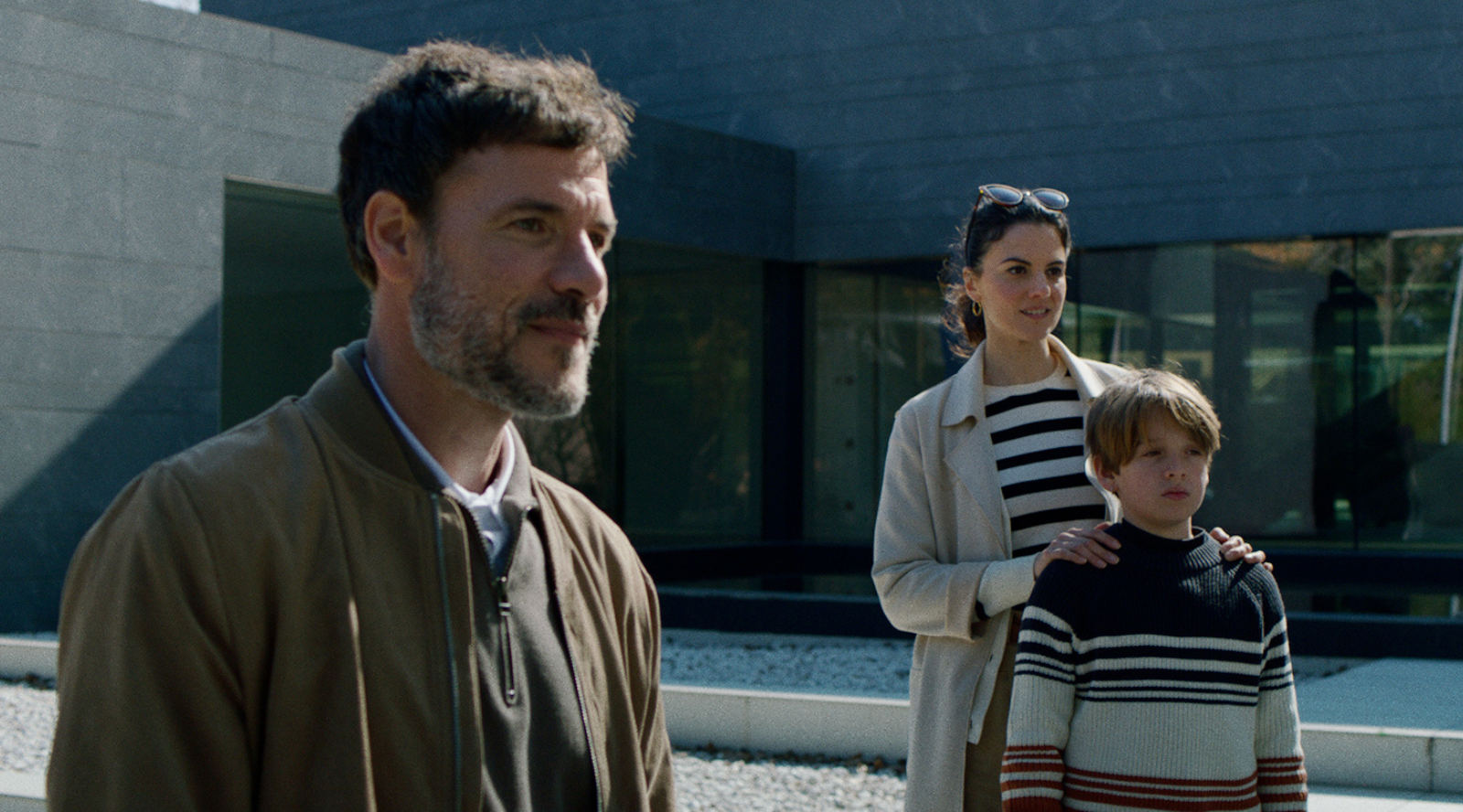
Centered in the same vein, “The Masterpiece” follows the affluent couple Leo (Daniel Grao) and the art-dealing Diana (Melina Matthews), who bring a broken TV to a recycling center and subsequently meet the black father-son scrap dealers Salif (Babou Cham) and the younger Yousef (Adam Nourou). To as much as Leo’s visible discomfort, Diana offers the duo “a good deed”, or more work: grabbing junk from the couple’s gated house.
Though the couple’s unease prompts last-minute hidings as soon as Salif and Yousef set foot on their ornate flooring, Diana is the first to let her go of her Cheshire smile as she eyes a very expensive painting in the back of the recycling van. Though not initially theirs, the couple’s tiny ask morphs into a tirade of prejudicial accusations aimed at the scrap dealers, underlining the short’s commentary on class and racism.
“The idea was to make a solid short film that was, more or less, tight on itself,” Lora said. “Although, you know, the final shot can leave some doors open for different interpretations.”

Though Cercós feels the film’s 20-minute runtime pushes the boundaries of a festival-submitted “short film,” it still secured his first “Grand Jury Prize” win at this year’s Sundance. At the heart of its acclaim, “The Masterpiece” rivals the potency of a full-length feature production. The film is a masterclass in tension, starting with Diana’s overcompensating hospitality, the not-so-secret security cameras that guard the couple’s house and Tesla that Yousef practically drools over, and the dubious bargain of a multi-million-dollar painting for a rusty family heirloom, and leaving viewers glued to the screen long after the end credits roll.
Though the film naturally converses in Spanish, it doesn’t take subtitles to understand that “The Masterpiece” is more than just about the ownership of the multi-million-dollar painting. The film’s native translation, “La gran obra”, also roughly translates to “the good deed”, a topic that the Spanish director describes as “a mirror” to wealthy folks like Leo and Diana, where the purity of their generosity towards the scrap dealers is just as dubious as offering a family heirloom that was previously “not for sale.”
The masterful toggle between dialogue and nuance in “The Masterpiece ‘’ leaves viewers a bit more engaged than the couple’s barely-there son Mario, who is looking beyond the floor-to-ceiling glass windows as his parents quarrel with the scrap dealers. “Even within the political spectrum, there are big contradictions concerning common values and ethics within the same group of people, especially in middle-high [economic] class, which is why [the film’s character] Diana is a big talking point,” Cercós points out. “She speaks the three languages of colonialism– English, Spanish, and French– and she also wants to feel like she’s doing something for the scrap dealers, but she’s not actually doing anything for them; she’s doing it for herself, to make herself feel better.”
Instead, what Mario doesn’t hear is what viewers spectate as classist hypocrisy: Diana and Leo pull the “race” card and, as the standoff crescendos, threaten the police and Salif’s place in Spain. With each offer and counter slamming down like chess players with their time clocks, Cercós succeeds in channeling his love for chess into a battle of wits, even imbuing the game’s checkered squares into the film’s cinematography to better highlight Salif and Yousef’s massive disadvantage. “I mean, [the film] is a fight from the beginning, right? I also believe racism is an economic issue, so I needed visual tension from the beginning, like two [chess] pieces on opposite sides [of the board],” Cercós says.

“Chess looks simple: it’s a square board on a table with some pieces there,” he continues. “But when you go beyond [the simplicity] and think about the game moves and strategy, that conceptual fight can turn into something very physical, especially since it’s a fast game– six minutes maximum. So it’s like a short film: you want to be fast. You can only think about the best move possible and pressing the ticking clock.”
During the editing process, though, Cercós swapped the traditional clock “ticks” for omnipresent drums, a motive he describes as “pure intuition” a la Mica Levi’s work for “Under The Skin”, sparking a compelling dissonance that reflects the film’s own arc that begins and ends with the couple’s black Tesla.
As the drums dissipate, Cercós admits that the final shot of “The Masterpiece” leaves room for different interpretations; however, having already cooked preemptive nuances that are served well done by the film’s final minute, Cercós’ cinematographic pan, through Youself’s empty picture frame towards the couple’s speeding Tesla, leaves a subtextually sour resolution, and an even more unpleasant reality check for the world today.
Leave a Reply