

Emerald Fennell’s latest writer-director project, “Saltburn,” prompts more than one lingering question at its end. One of the most pressing — What was Oliver Quick (the film’s deceiving protagonist) really after? While the feature received widespread praise and acclaim across its series of world premieres, including opening the 67th BFI London Film Festival (2023), and boasts an impressive cast lineup — Barry Keoghan (The Killing of a Sacred Deer, The Banshees of Inisherin), Jacob Elordi (Priscilla, Euphoria), Rosamund Pike (Gone Girl, I Care A Lot), Archie Madekwe (Gran Turismo, Midsommar), Alison Oliver (Conversations With Friends, Best Interests), Richard E. Grant (Withnail and I, Can You Ever Forgive Me?), and Carey Mulligan (The Great Gatsby, Promising Young Woman) — it ultimately leaves glasses half-full. Fennell’s attempt at an art-house thriller feels mostly stocked with shock value, made up of a half-baked story, leaving its actors to embellish.
The story, set in the gothic and gritty world of “Saltburn,” isn’t quite interested in dissecting the psychopathology of its characters and their vapid, mostly unclear reasonings. Instead, it explores the underbelly of the green-eyed monster that lives within us all, told through the lens of an unreliable narrator who is an outsider gazing longingly at the fine elitist world of excess and simultaneously destroying it all in a summer’s time. There is seemingly no reason — at least not one the viewer is given — only envy.

Opening in the year 2006, the film centers on Oliver Quick (Keoghan), a middle-class, friendless student attending Oxford college on a scholarship, who finds himself infatuated with the quintessential campus-favorite prepster, Felix Catton (Elordi). A chance encounter wherein Oliver stumbles upon a stranded Felix, lending him his bike, marks the beginning of an interesting friendship dynamic — one stuck in a perpetual child-like imbalance wherein Oliver’s growing obsession with Felix only fuels the latter’s own neediness. The film’s best moments come from the pair’s innocent post-adolescent boyhood, forging identities from Oliver’s addict parents and Felix’s misunderstood too-good life.
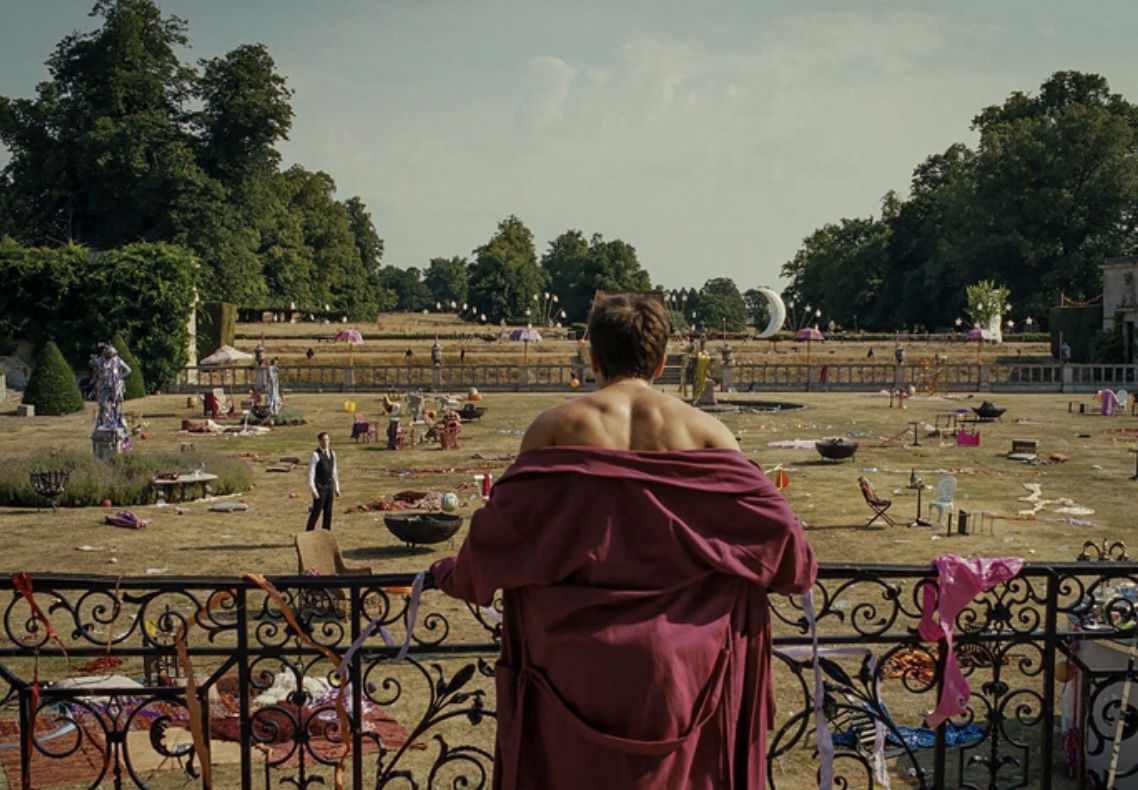
The second act opens after Oliver receives news of his father passing away, after which Felix extends to Oliver an invitation for a summer getaway at his inconceivably glorious family estate, called Saltburn. It’s an untouched Gatsby-esque mansion where black-tie family dinners are the standard, decorated with Bernard Palissy ceramic platter and sitting on a grassy expanse, one-upped with rolling fields, little ponds, and a dizzying garden maze. Inside the sodden walls, Oliver, along with Farleigh (Madekwe), unknowingly are the blasé Saltburn residents’ primary source of amusement. Before, it was Poor Dear Pamelia (Mulligan) whose self-inflicted death upon leaving Saltburn Felix’s gossipy mother, Elspeth (Pike), wrote off as a call for attention.

With his intelligent brain and pretty blue eyes, Oliver similarly objectifies the family by indulging in their specific guilty pleasures (i.e., gossiping with Elspeth and seducing Felix’s absent-minded and sexually frustrated sister Venetia, portrayed by Alison Oliver), slowly weaseling into the standoffish Saltburn clan. However, as Oliver’s true background enters the family premise, his games take a vengeful turn of life and death (Venetia herself eventually vocalizes the presence of “stranger danger,” but it comes too little too late).
“Saltburn” director Emerald Fennell’s previous directorial pursuit, an Oscar-winning dark comedy “Pretty Young Woman,” starring Carey Mulligan as a rape victim seeking vengeance on her wrongdoers, was a critically acclaimed knockout. While the young talent has a knack for skyrocketing heart rates, “Saltburn” possesses the suspense levels of a surprise birthday party: it’s almost too predictable. Instead, all the dialogue-depth budget went straight to the aesthetically picturesque set, along with what can be assumed to be a high price to subject Keoghan to prancing naked throughout the estate and enacting sexually overkill while perhaps true to unhinged insanity bathtub-licking and grave-fucking moments.

That’s not to say Fennell is devoid of one-line antidotes, but most felt unrealized and reduced to the drunken drivel spouted by Venetia. “I think you’re a moth,” she tells Oliver, “quiet, harmless, drawn to shiny things, and desperate to get in.” Rather than expanding the imagery around Oliver’s unprecedented ascent in Saltburn — aside from the painfully obvious meaning behind Oliver’s birthday party deer antlers — the film’s final portion laments on the dissolvement of Elspeth and Sir James’s pointless banter as the best analogy to Saltburn’s downfall.
Even Felix’s distant friend Farleigh, the film’s token Black character, only ever hits one note in the two-hour film, hating on Oliver. Truthfully, Fennell could’ve created a more well-rounded rivalry that tied in both the character’s “play toy” statuses and personal situations that left the bedroom, but Farleigh simply doesn’t have the screentime to do anything but blow steam.

Beyond the lack of a hearty plot, no sustenance rooted Oliver’s devious plot other than pure mind-racing obsession, leaving the British 2000s soundtrack the only supplement to his unbeknownst inner workings. Though pumped with every party anthem imaginable from MGMT, Arcade Fire, and Girls Aloud, there was a breathtaking rendition of “King Of All Hopefulness” by York Minster Choir, which, in its three-minute duration, gave great depth to Oliver’s unrealistic sadness, further unsettling Venetia — one of a handful emotionally tangible moments from the 127-minute runtime.
Although “Saltburn” isn’t an outright failure, it doesn’t live up to Fennell’s promising and extremely limited director catalog of “Promising Young Woman” and “Killing Eve.” At a glance, the film sets an amazing groundwork for a one-way ticket to being an art-film critic darling. Instead, Fennell leaves the championed actors to pull up the movie by the bootstraps despite a lackluster script cosplaying pseudo-existential dialogue. Together, the surface-level writing and directorial inexperience make for a slow-paced and frankly boring two-hour introduction to the expansive Saltburn property and Fennell’s poor take on toxic elitism via watered-down residents who think sexual frustration is a personality trait.
Leave a Reply