Category: fashion

  • Heritage in Motion: Team USA by Ralph Lauren

    Heritage in Motion: Team USA by Ralph Lauren

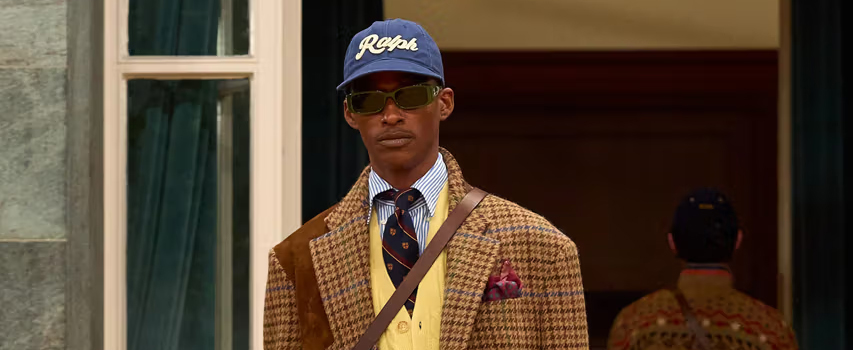
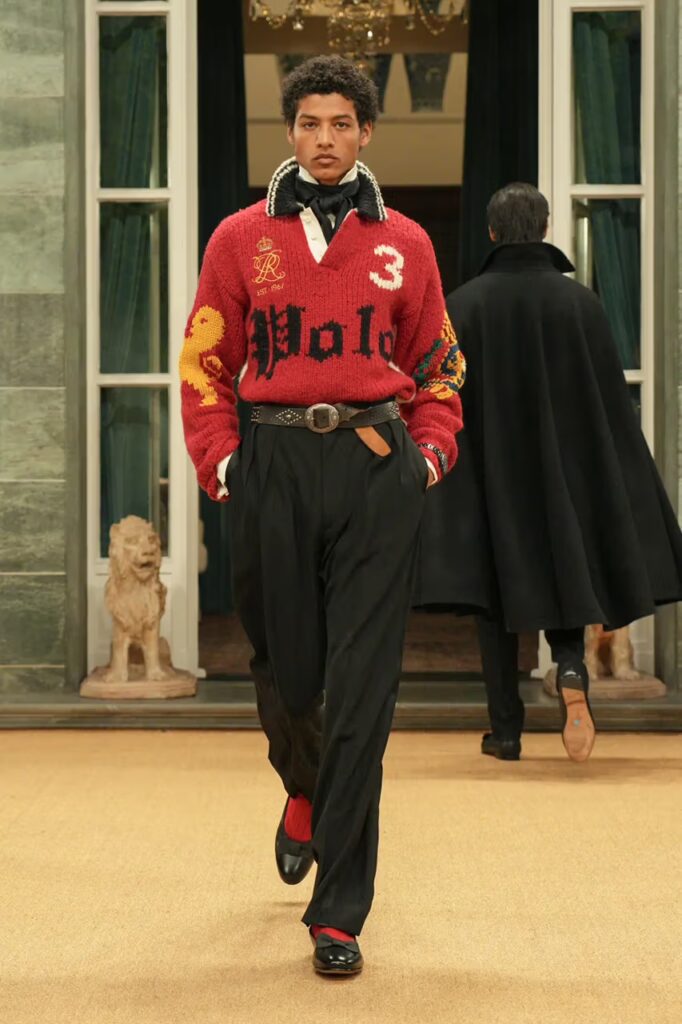
    For nearly two decades, Ralph Lauren has been quietly shaping the visual language of American athletic ceremony. For the Milano Cortina Winter Olympics, that legacy continues with two sharply defined uniforms for Team USA each one speaking a different dialect of the same story. One rooted in heritage and craft, the other in motion and modern performance. Together, they form a conversation between past and future, tradition and velocity.

    The Opening Ceremony look leans into Ralph Lauren’s Americana DNA. An ivory wool duffle coat anchors the silhouette, finished with wooden toggles that feel archival rather than nostalgic. Beneath it, an American flag intarsia turtleneck and tailored wool trousers sharpen the look into something ceremonial without becoming theatrical. It’s formal, but warm designed to stand still under stadium lights while carrying the weight of national symbolism with restraint.

    For the Closing Ceremony, the tone shifts. The duffle gives way to a bold, color blocked puffer jacket that feels kinetic, almost aerodynamic. Team USA graphics take center stage, paired with a streamlined wool turtleneck and crisp white utility pants that nod to athletic function. It’s less about heritage and more about momentum what comes after the medals, the march forward, the quiet confidence of competition completed.

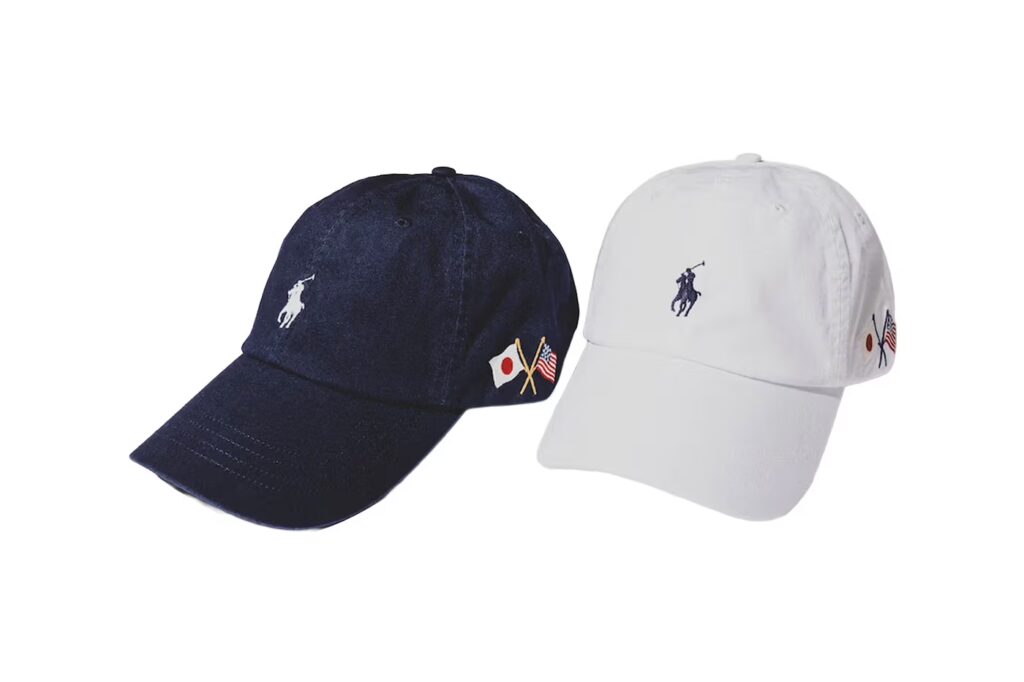
    Accessories tie both looks together: intarsia knit hats and mittens in red, white, and blue, brown suede alpine boots, leather belts details that matter because they’re considered. Every piece is made in the USA, reinforcing the collection’s ethos not as costume, but as craft. As David Lauren notes, these uniforms aren’t just garments they’re stories, designed to reflect optimism, excellence, and the enduring American spirit against the backdrop of Milan, one of fashion’s grat capitals.

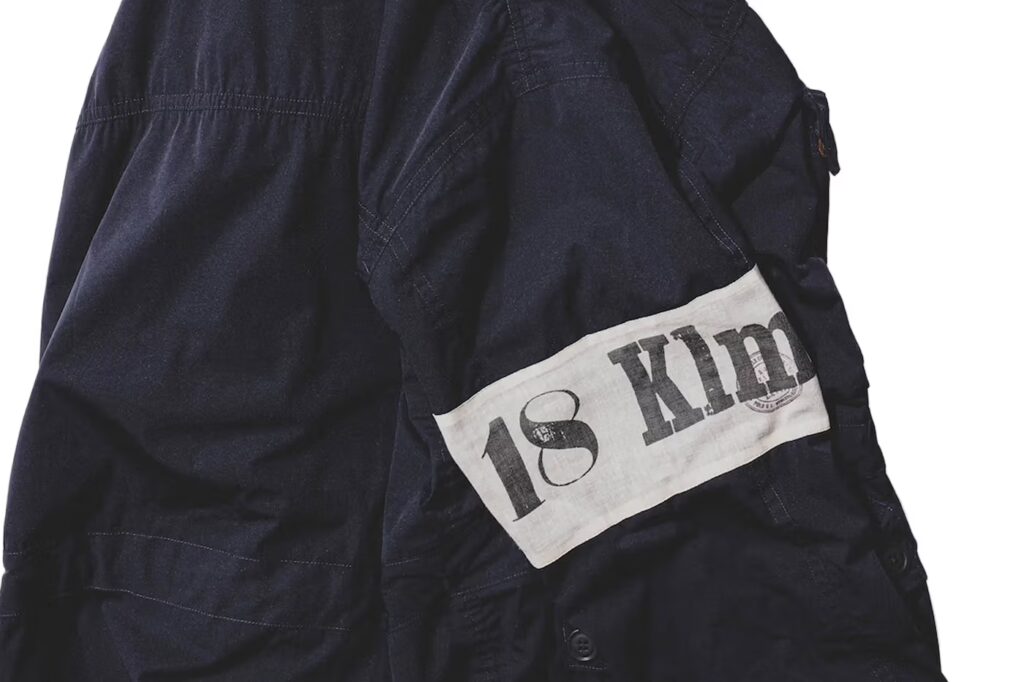
    Beyond the ceremonies, the Ralph Lauren Team USA Collection extends that narrative to the public. Military inspired outerwear, leather flight jackets, olive bombers, and Olympic marked essentials bring the same palette and intention into everyday wear for men, women, and children alike. It’s not merch. It’s continuity. A reminder that style, when done right, can carry meaning long after the final torch is extinguished.

    PINES STUDIO

  • NIKE X Jacquemus Après Ski Designed for the Elements

    NIKE X Jacquemus Après Ski Designed for the Elements

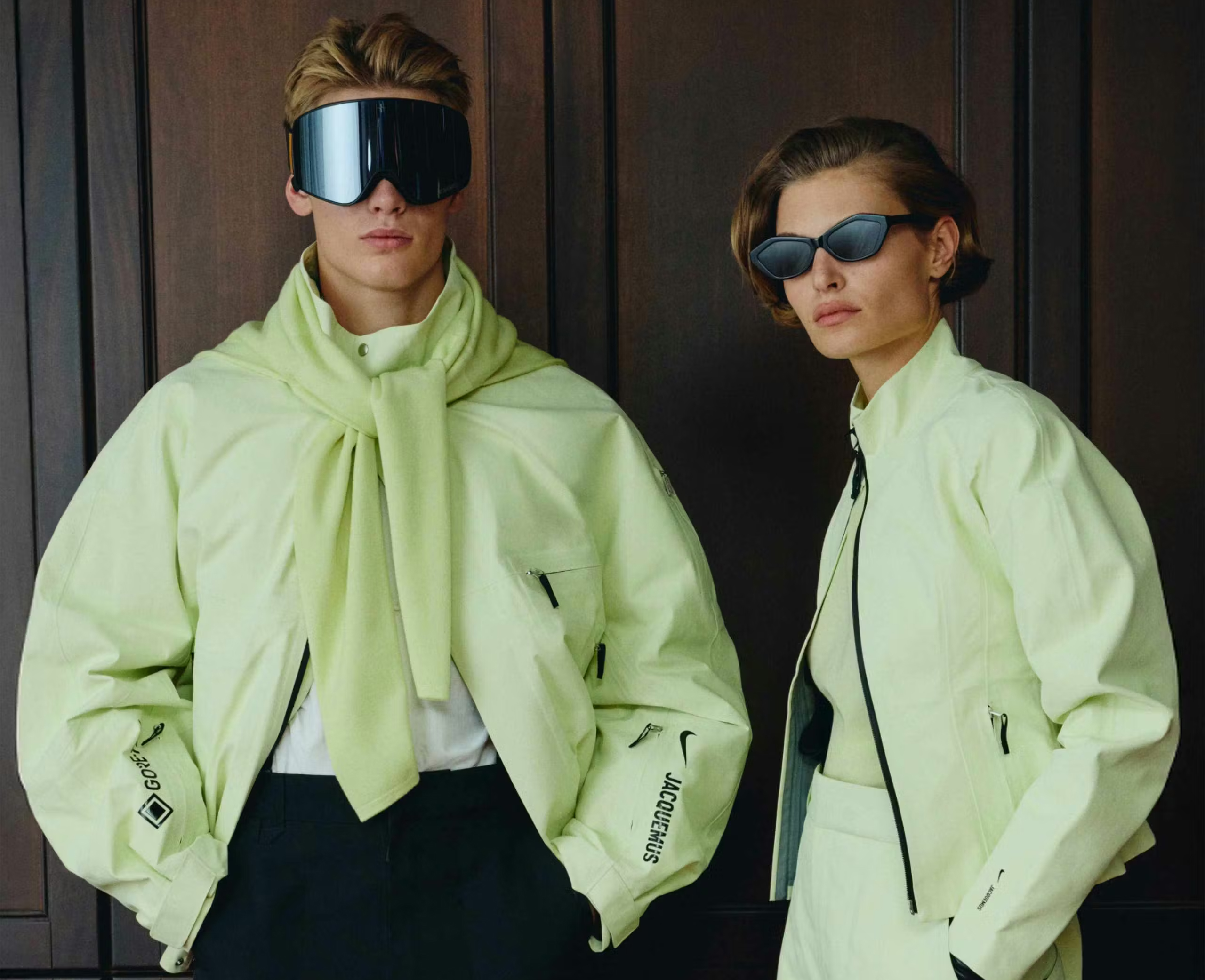
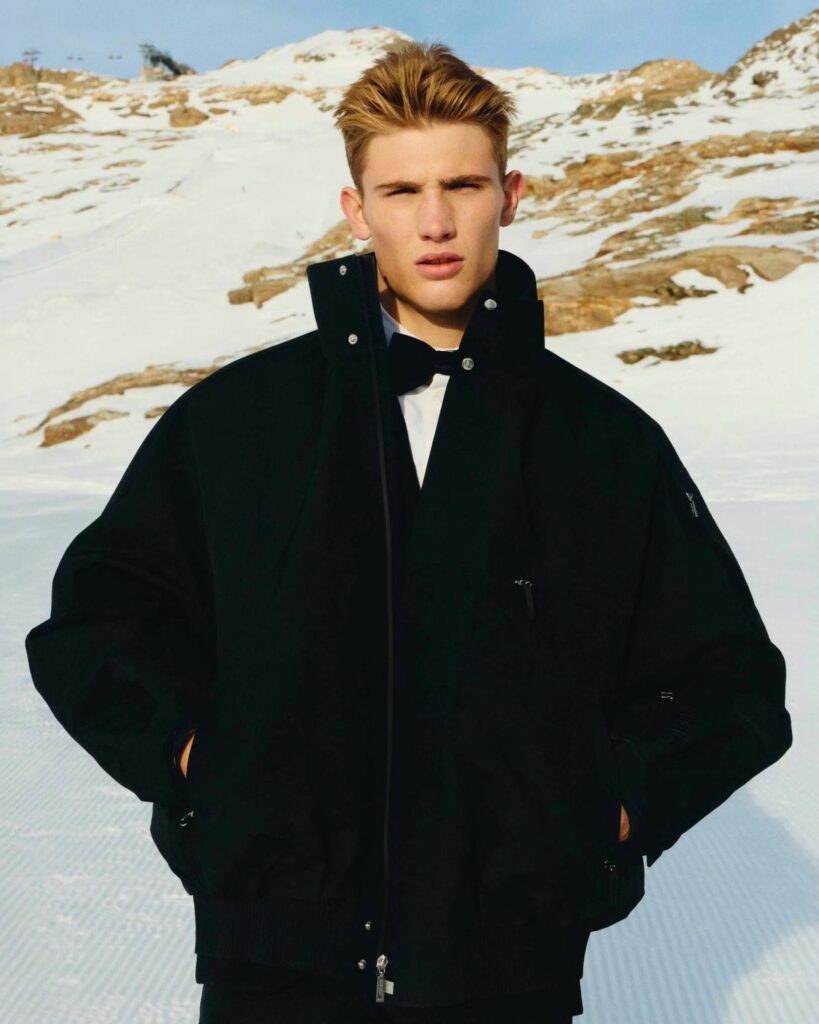
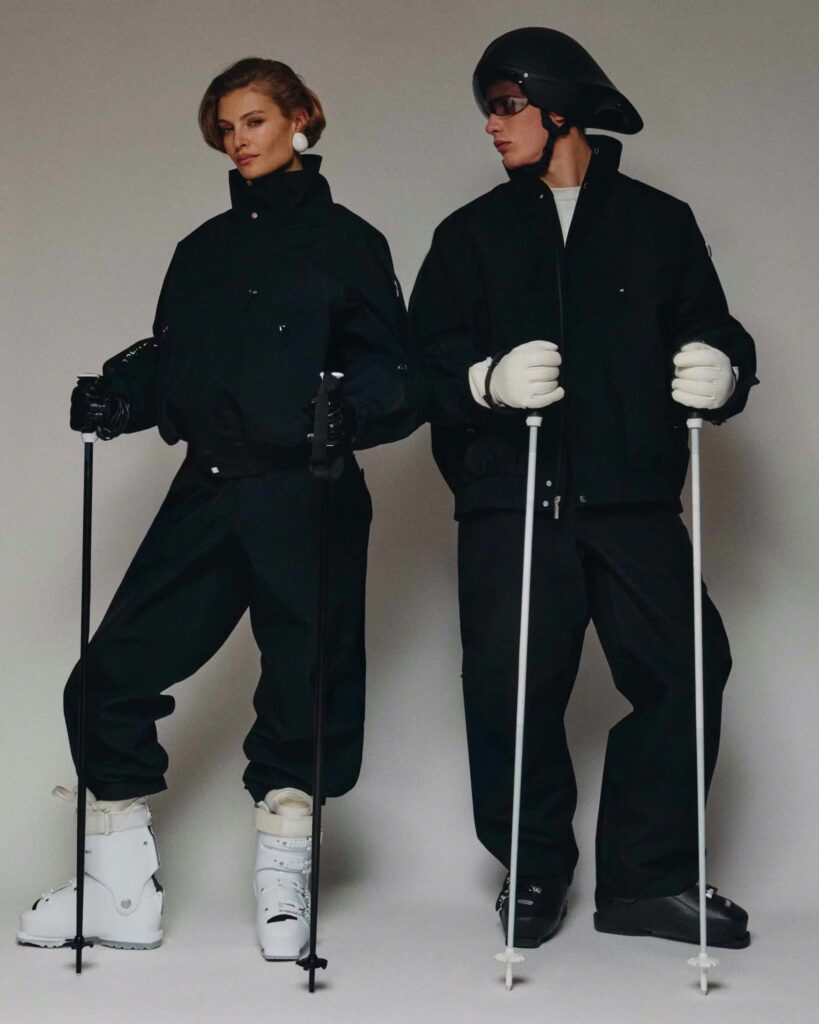
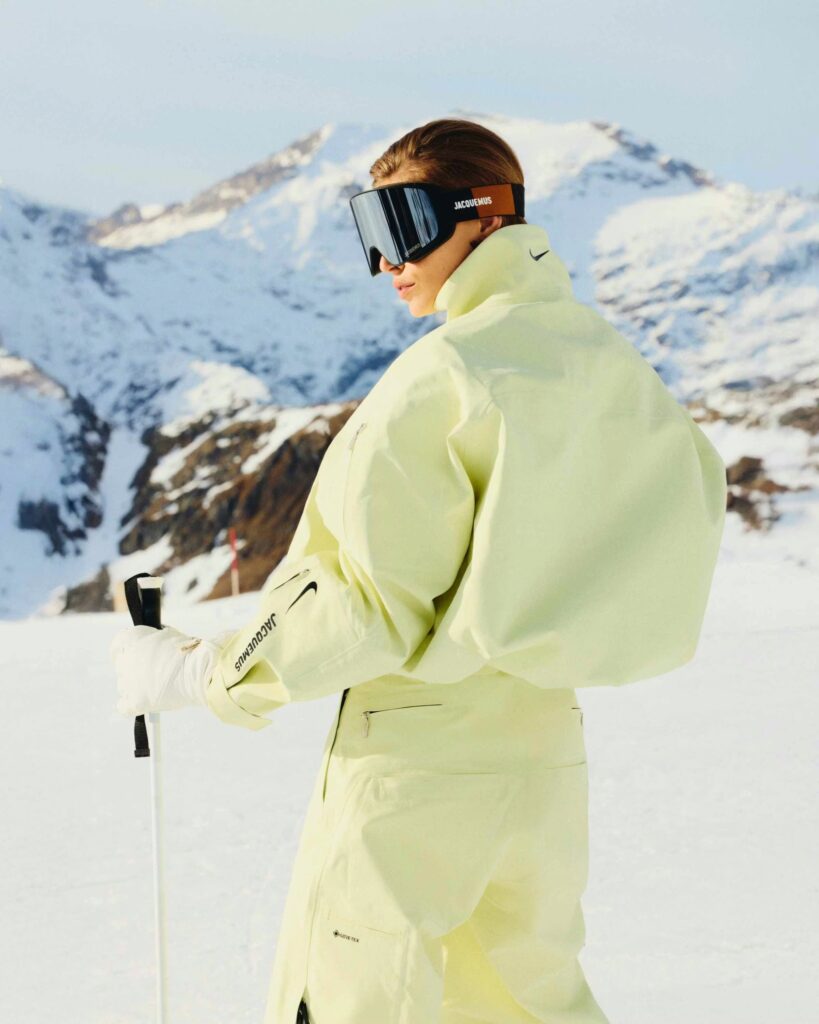
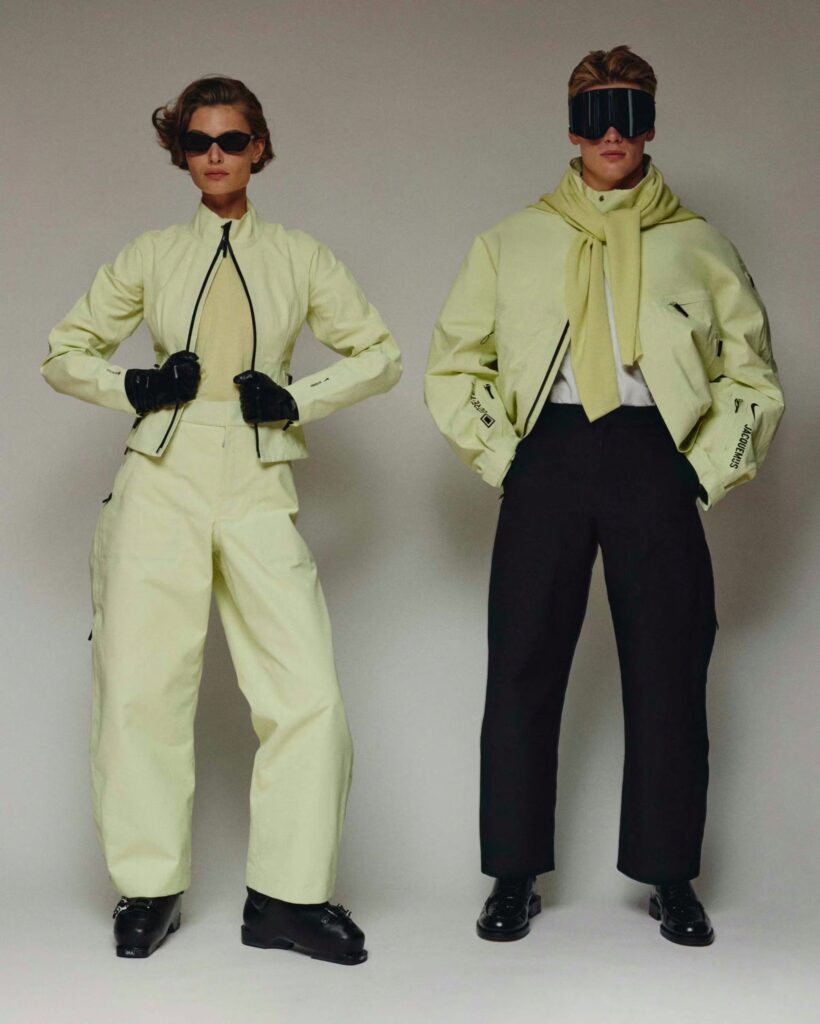
    The new Nike x Jacquemus Après Ski collection arrives as a quiet yet powerful statement on what modern winter performance can look like when precision meets poetry. Built as an 18 piece capsule, the range moves effortlessly between alpine utility and sculptural minimalism. Technical outerwear constructed with advanced weather resistant fabrics is softened by Jacquemus’s refined eye for proportion, color, and silhouette proving that function no longer has to compete with form.

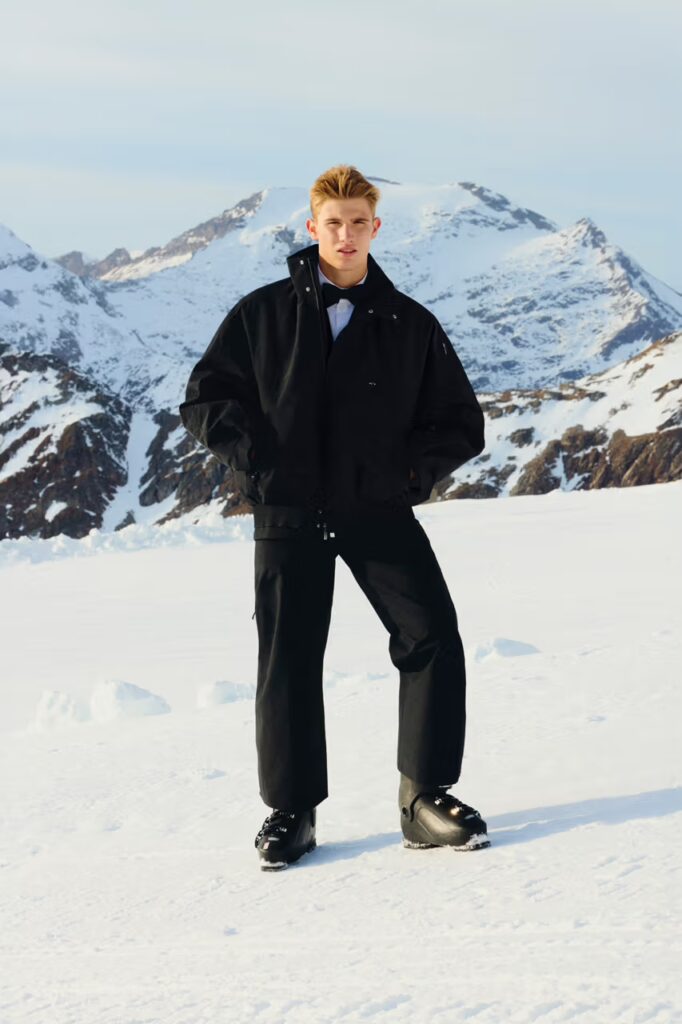
    Designed to live both on the mountain and beyond it, the collection offers a tightly edited wardrobe of winter essentials: streamlined outer shells, tailored snow pants, and lightweight insulating layers that echo the nostalgic codes of vintage ski culture while feeling distinctly current. There’s a subtle nod to the glamour of 1980s alpine style, but reinterpreted through a modern, restrained lens each piece engineered for movement, protection, and visual clarity.

    For Simon Porte Jacquemus, the collaboration represents more than just a seasonal drop it’s a personal dialogue with a sport and lifestyle that shaped his upbringing. His lifelong connection to skiing and his fascination with archival winter gear are woven into the DNA of the collection, translating personal memory into contemporary design. Partnering with Nike’s technical expertise allowed Jacquemus to push into new territory, merging high-performance craftsmanship with his signature minimal sophistication. The result is a collection that feels equally at home cutting through fresh powder or standing quietly at the edge of an alpine horizon a new chapter in the language of modern après ski.

    BY PINES STUDIOS

  • SWEETEST ME A WORLD BY MAHIRU | A Pines Studio Feature

    SWEETEST ME A WORLD BY MAHIRU | A Pines Studio Feature

    There’s something disarmingly honest about Sweetest Me. It doesn’t announce itself as a concept album it simply breathes. Mahiru didn’t start with a grand message or storyline; she started with truth.

    Each song became a timestamp a snapshot of her emotions, her friendships, her quiet introspections. The result feels like pages torn from a private diary, where love and solitude co-exist without explanation. It’s not confessional for attention it’s confessional because it’s real.

    “I just wanted to make music that felt honest like whatever I was actually feeling in that moment.”


    If Mahiru’s past work lived in the fog of dreamy melancholy, Sweetest Me is sunlight after rain still tender, but warmer. Working with close friends shifted her creative chemistry; the sessions felt more like late-night conversations than studio marathons. That intimacy radiates through the record’s palette playful synths, candid laughter, and pauses that sound like she’s smiling between lines.

    “I worked with people around my age friends I hang out with on a regular basis and that chill, fun energy definitely came through in the songs.”

    The emotional spectrum widens from the gravity of heartbreak to the weightlessness of new beginnings. Mahiru doesn’t discard her melancholy; she redefines it.


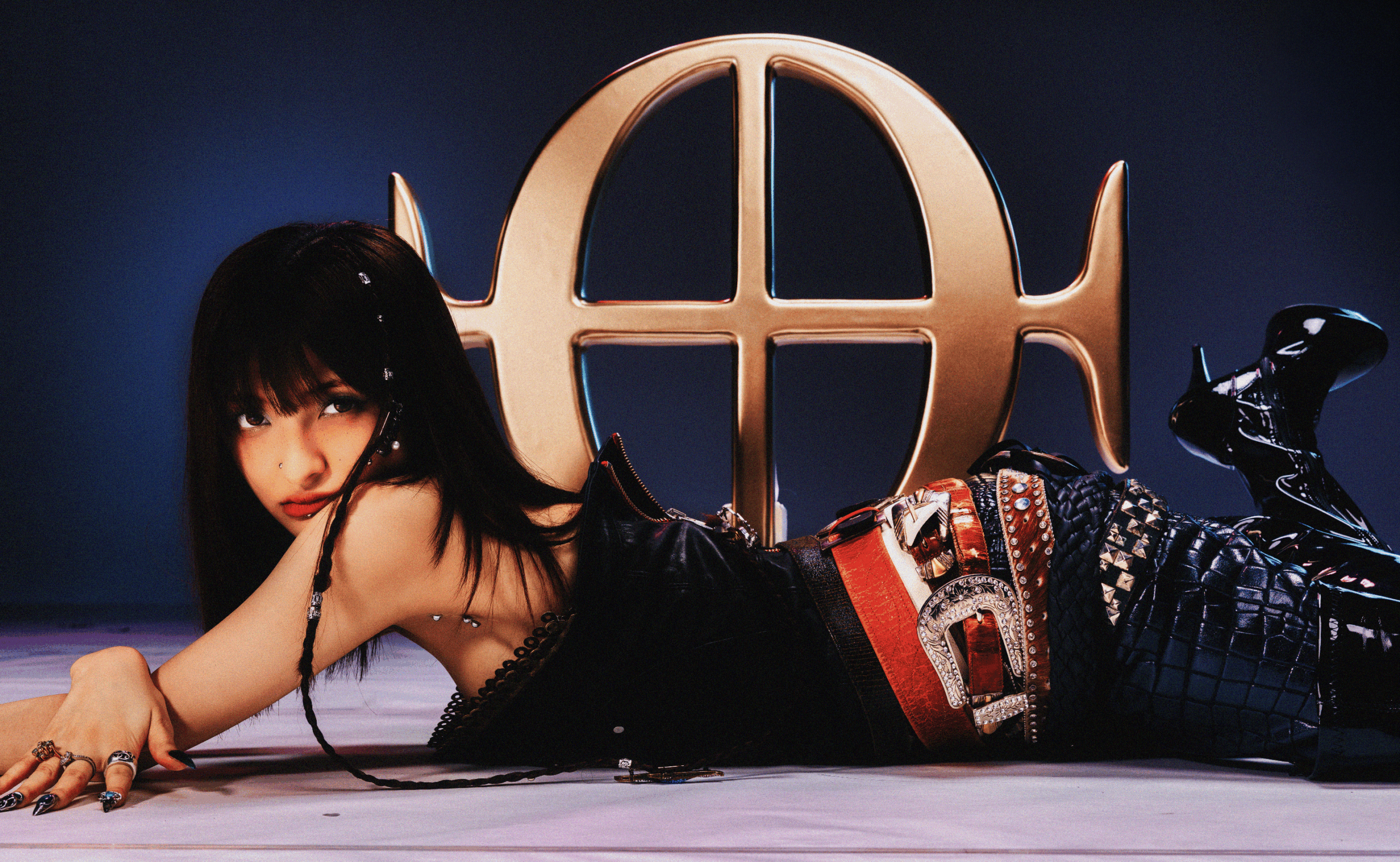
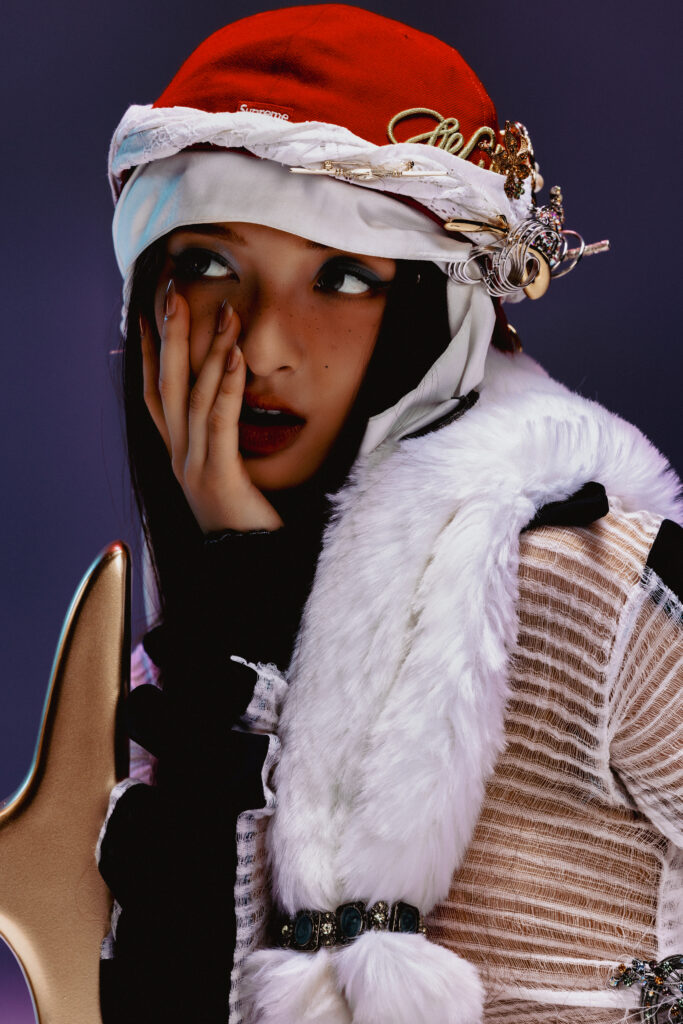
    The world of Sweetest Me extends beyond sound into the lens. Shot by Badboi, the cover captures Mahiru in her purest form: stripped down, luminous, framed by her signature Chordal Mark. The stark white studio and her minimal styling create a stage for sincerity no theatrics, no filters.

    Mahiru’s vision led the process; she designed the look, the pose, the mood. Together, the collaboration crystallized into an image that feels like silence after truth still, cinematic, alive.

    “Since this project is all about self-expression, I wanted the visuals to feel raw just me, in a simple space.”

    When the album ends, it doesn’t fade it lingers.

    The echo remains, suspended in the room, a quiet reminder that vulnerability can be the loudest thing in art.

    “I want listeners to feel overwhelmed like they need to go back and listen again just to process what happened.” – Mahiru

    by PINES STUDIOS

  • The Dialogue of Worlds: Murakami x Louis Vuitton 2025

    The Dialogue of Worlds: Murakami x Louis Vuitton 2025

    For more than two decades, Takashi Murakami’s relationship with Louis Vuitton has reshaped how we understand the intersection of fine art and luxury. What began in 2003 with the now iconic Monogram Multicolored under Marc Jacobs has evolved into a fully realized artistic dialogue one that fuses the Maison’s meticulous savoir-faire with Murakami’s hallucinatory imagination.

    In the 2025 Artycapucines collection, that conversation reaches new depth. “Over the past 20 years, from my first collaboration to this 2025 project, I believe Louis Vuitton’s atelier has made remarkable technological advancements,” Murakami reflects. He speaks with the curiosity of an artist who has witnessed the evolution of craftsmanship firsthand: three-dimensional modeling, advanced metalwork, even the inclusion of materials once deemed impossible, like denim. The collaboration feels like a reunion between two perfectionists chasing the same horizon where technology and art meet handwork and dream logic.

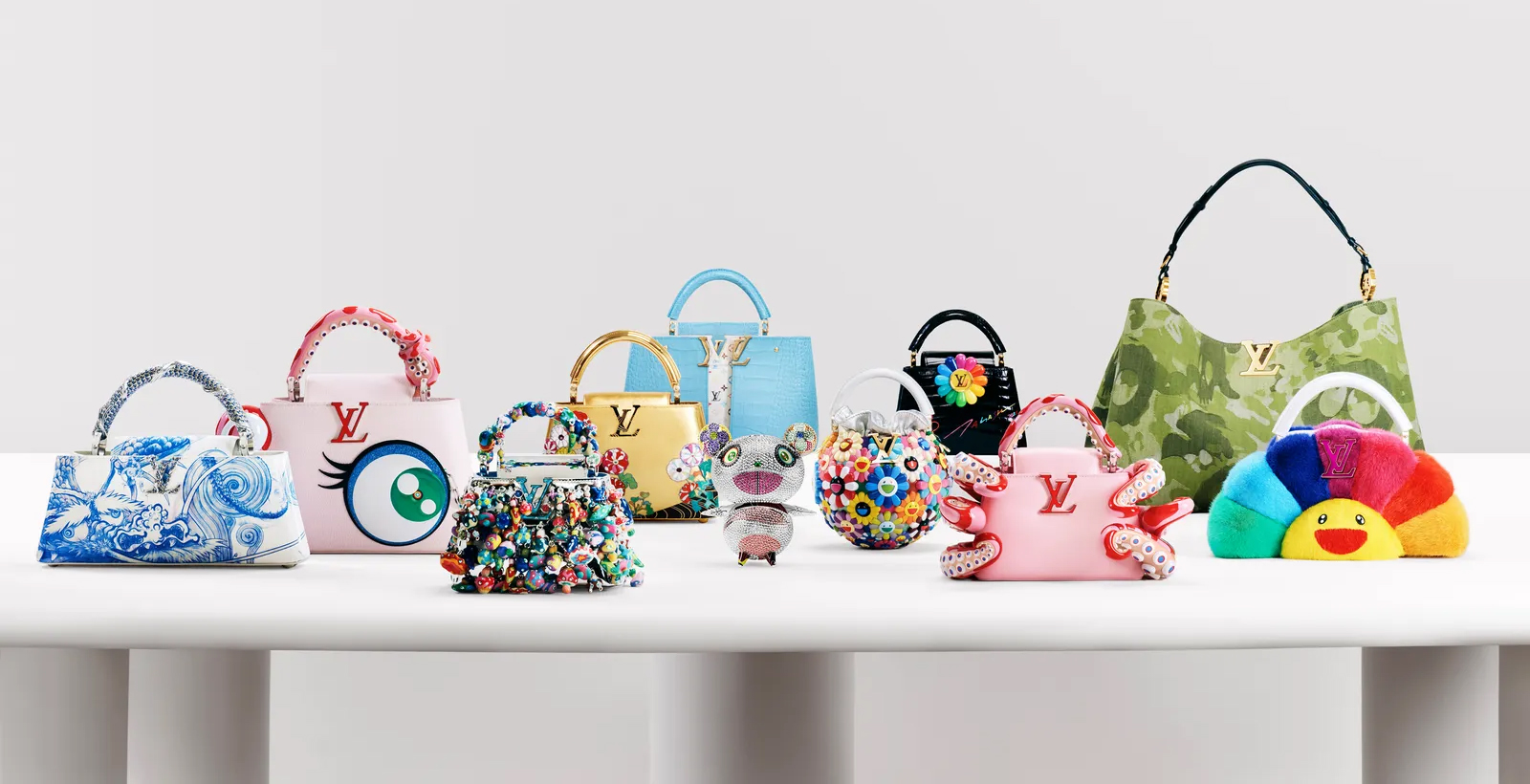
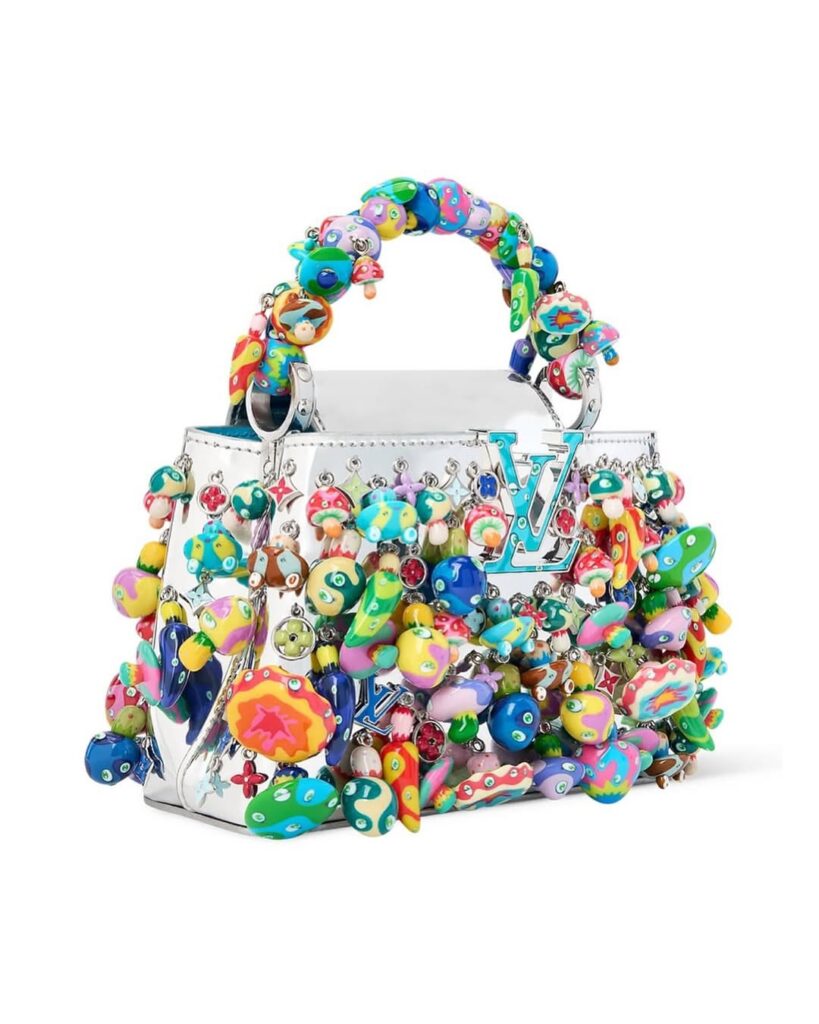
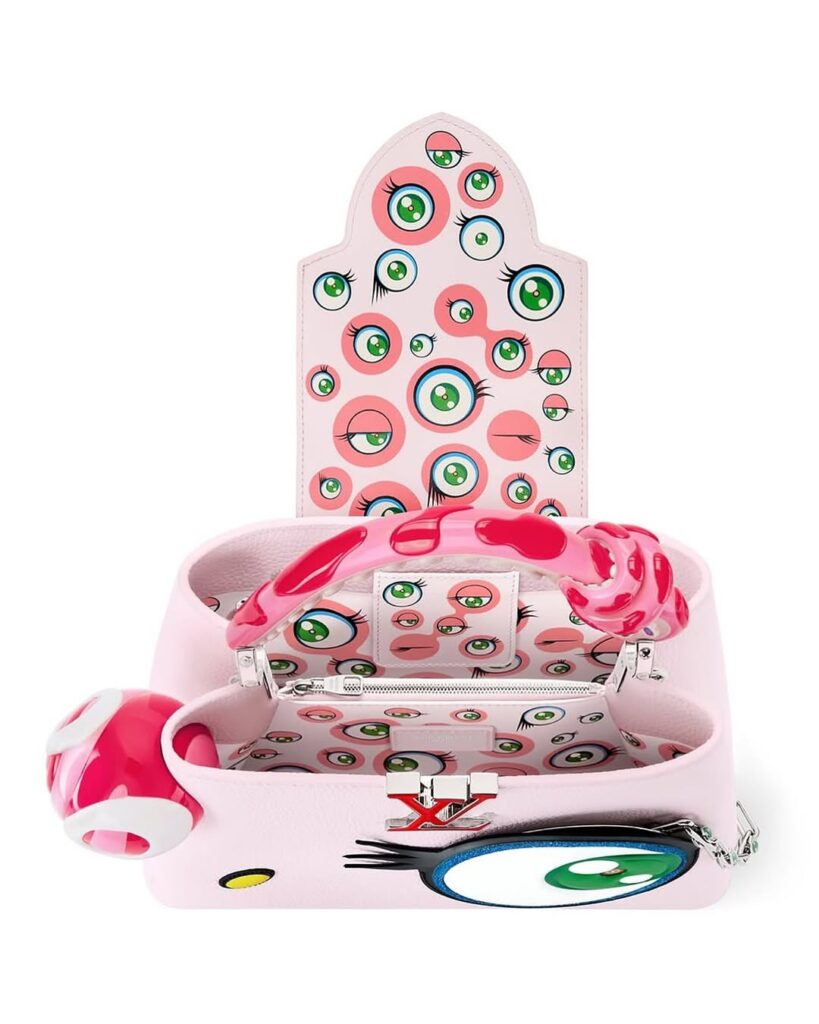
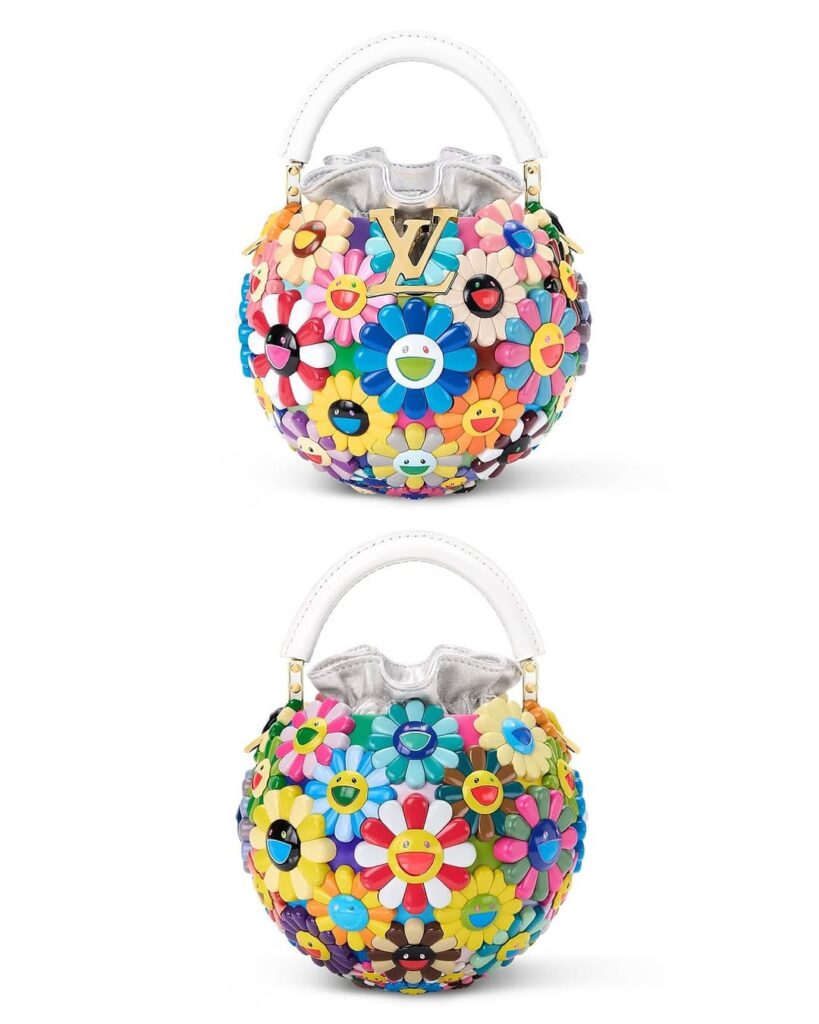
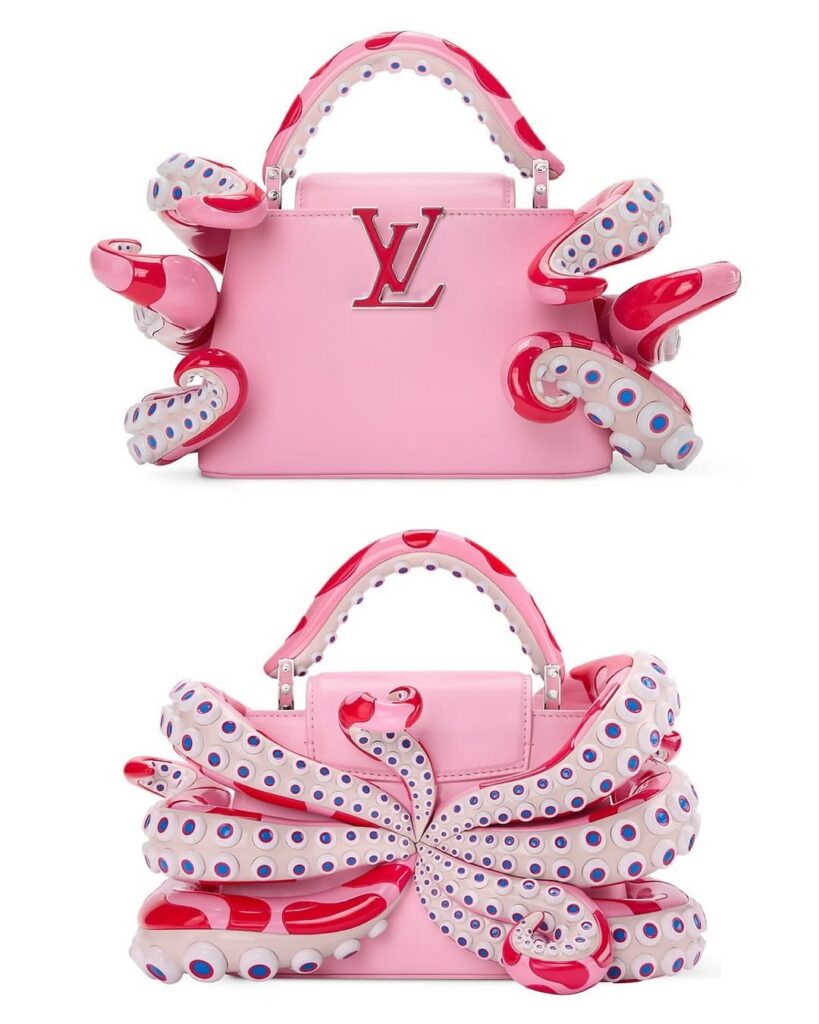
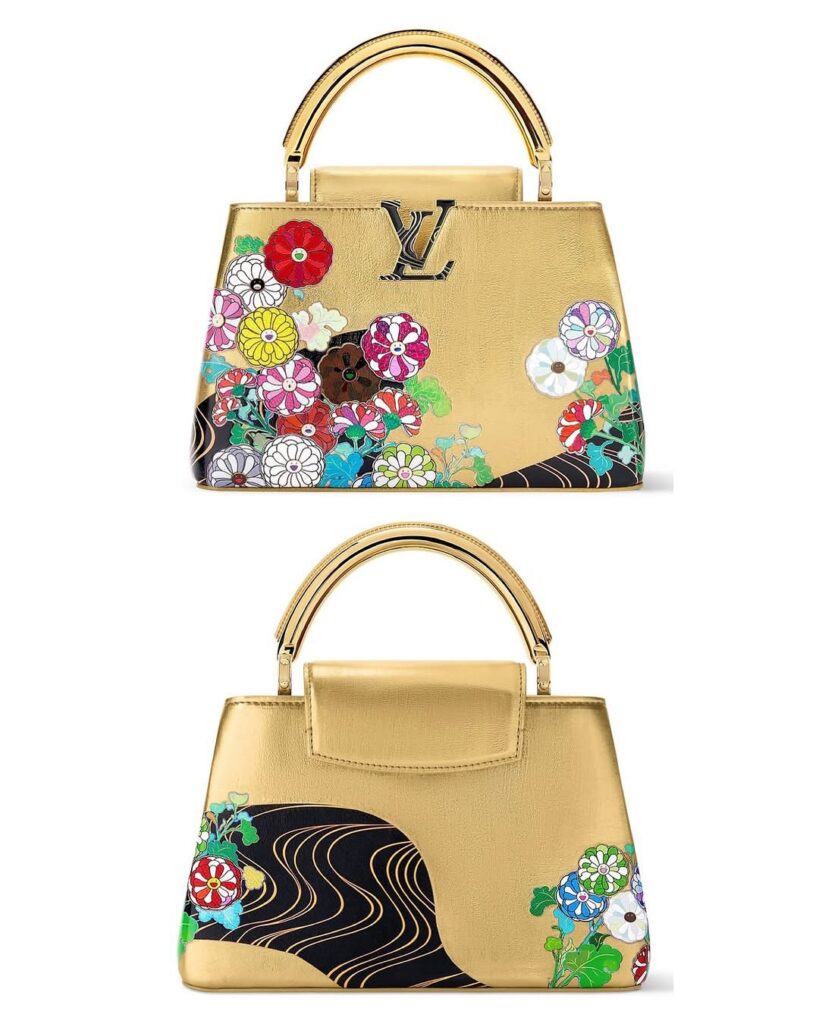
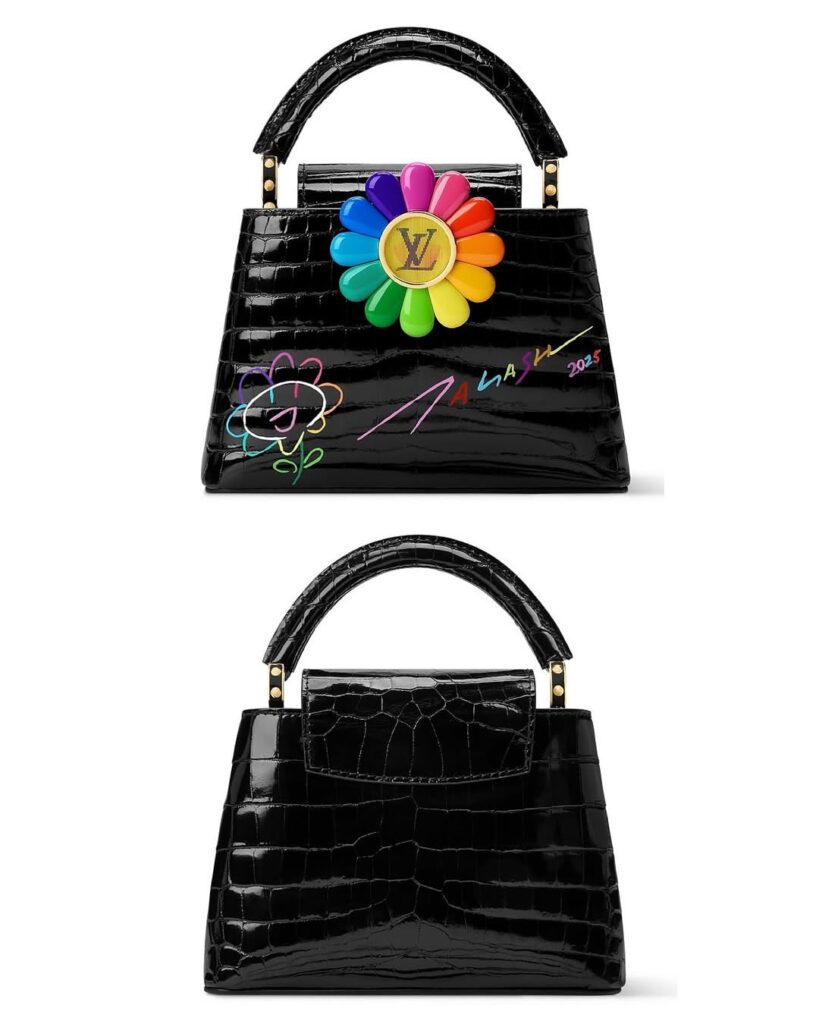
    Each bag in the series becomes a portal into Murakami’s expanding cosmos. The Capucines EW Rainbow erupts into a prism of lacquered hues, distorting the bag’s classic silhouette into a euphoric display of color. The Mini Mushroom, with a hundred of his signature fungi hand-polished and embroidered on mirrored silver canvas, feels like a psychedelic garden you can carry. The Mini Tentacle, perhaps the most sculptural, transforms his alter ego Mr. DOB into a playful marine form a pink creature both charming and otherworldly. Then there’s the EW Dragon, a wearable echo of his monumental Dragon in Clouds Indigo Blue painting, and the Capucines BB Golden Garden, a symphony of leather marquetry and gold-leaf luminosity that nods to Vuitton’s heritage of refinement.

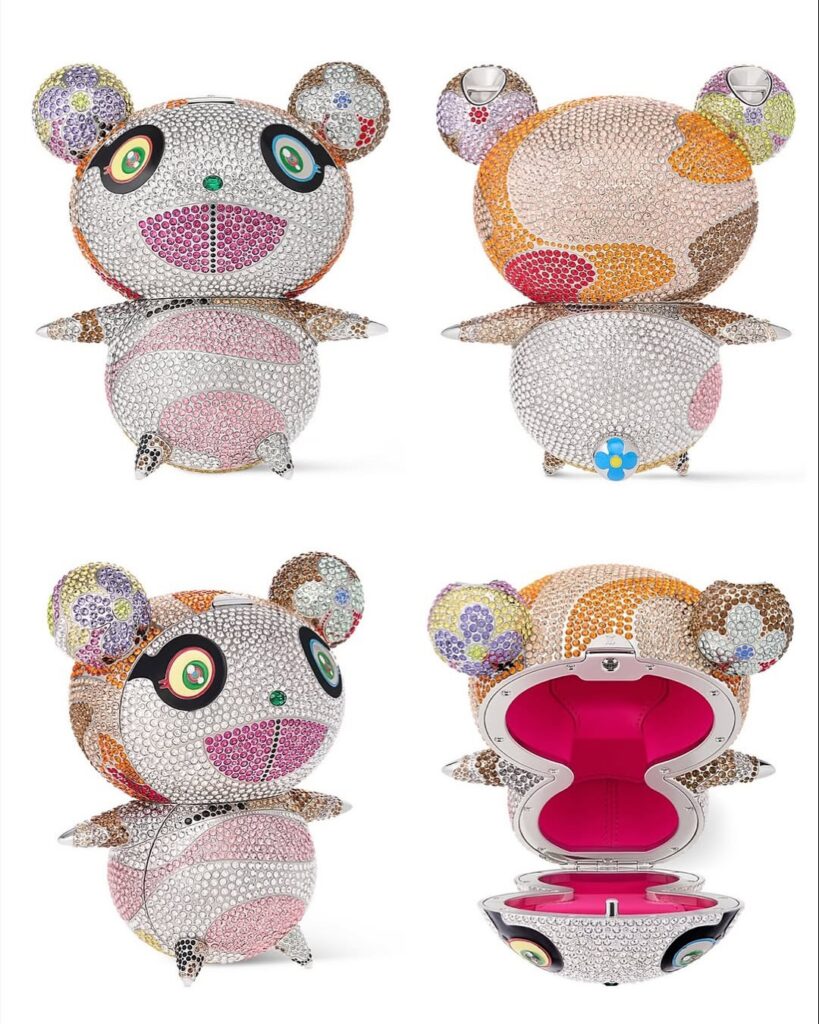
    The most striking of all may be the Panda Clutch a silver-tone brass sculpture studded with 6,250 strass stones, bridging jewelry, sculpture, and collectible design. Together, these pieces read like a museum show masquerading as an accessories collection.

    What distinguishes this collaboration is its mutual reinterpretation. “Without being fixated on my distinctive characters, Louis Vuitton incorporated motifs ranging from the classic to the majestic like the dragon,” Murakami notes. Vuitton’s artisans deconstruct his visual language his color fields, patterns, and creatures and reassemble them into handles, clasps, and inner linings. The result is not mere decoration but a synthesis: Murakami’s universe filtered through the disciplined choreography of French craftsmanship.

    The 2025 Artycapucines collection isn’t just an expansion of Vuitton’s art dialogue it’s a statement on how luxury and imagination can coexist. It captures a moment where the atelier becomes an artist’s studio, and a handbag becomes a sculpture that breathes.

    — Studio by Pines

  • Maison Margiela’s Next Canvas: The Home

    Maison Margiela’s Next Canvas: The Home

    Maison Margiela is extending its quiet rebellion beyond the runway into the realm of living.

    Its debut residential project, Maison Margiela Residences, is set to rise on Dubai’s Palm Jumeirah, with only 25 limited homes that blur the line between architecture and couture. Each residence looks outward to the sea and inward to Margiela’s philosophy: transformation through deconstruction.

    For over three decades, the Maison has treated design as an act of storytelling stitching together ideas across fashion, furniture, and form. This new venture continues that language, where walls behave like garments and materials carry the poetry of imperfection. Red marble, aged mirrors, and precise tailoring become architectural gestures rather than decorative choices.

    In collaboration with Alta Real Estate Development, the project imagines what happens when Margiela’s codes trompe l’œil, reconstruction, and restraint translate into space. It’s a study in controlled disorder, where the intimacy of couture meets the permanence of structure.

    Italian architect Carlo Colombo contributes a collection of bespoke furnishings crafted exclusively for the residences. His approach sculptural, deliberate, quietly cinematic builds harmony between the architecture and what lives within it. The result is a world where Margiela’s unconventional philosophy can be lived, not just worn.

    Beyond luxury, Maison Margiela Residences represents a shift: a home as narrative, a structure as statement.

    The Maison continues its exploration not to decorate life, but to design its atmosphere.

  • Art Don’t Die Studio by Pines Collection

    Art Don’t Die Studio by Pines Collection

    Art has never belonged to time. It moves through it shapeshifting, surviving, leaving traces on those who dare to create. Art Don’t Die is a reflection on that immortality. A collection that honors the artists who turned imagination into rebellion, whose visions continue to haunt galleries, streets, and minds alike.

    At the center of the collection stand two titans Salvador Dalí and Jean-Michel Basquiat. Dalí, the surrealist dream architect who painted the subconscious into elegance; Basquiat, the poet of the street whose chaos became scripture. Together, they represent two ends of a spectrum precision and impulse, order and riot. Studio by Pines reimagines them not as relics, but as living symbols of defiance.

    Each tee is built like a relic unearthed heavyweight cotton washed into softness, carrying the weight of history. The prints are bold yet ghostly, fading as if they’ve lived lifetimes. The red Pines Studio mark bleeds like a signature of gratitude, a pulse that reminds us: true art never dies, it only finds new vessels to live through.

    shot by @badboi

  • BARCELOS : THE ARCHITECT OF SHADOWS | A Pines Studio Feature

    BARCELOS : THE ARCHITECT OF SHADOWS | A Pines Studio Feature

    In Barcelo’s universe, fashion isn’t designed it’s written. Each garment, each thread, each silhouette is part of an unfolding narrative a story told in chapters, like episodes from a world that doesn’t quite exist yet, but somehow feels familiar.

    “The idea was to build a brand that doesn’t follow the traditional format,” he says softly. “Something more like a series where every collection becomes an episode, revealing new characters, new cities, new fragments of a world in motion.”

    This world is not so far from our own. A near future that mirrors today’s obsessions power, technology, control only pushed a little further, until it starts to blur. Here, the powerful monopolize not just economies but emotions. Here, the garments are both armor and confession.


    The Story Before the Stitch

    Before there were clothes, there were characters.

    He began not with fabric, but with fiction imagining who these people are, what they fear, what they protect, and what they hide. “I create the characters first,” he explains. “Then I decide what they would wear, what the texture feels like, how the light would move across the fabric.”

    He draws from the worlds of Blade RunnerStar WarsThe Mandalorian  stories that dream of the future but ache with something human. Each piece becomes an extension of its character worn not for style, but survival.

    It’s a process more like directing than designing. A cinematic ritual where concept and craft orbit the same sun.


    The Language of Disguise

    At the heart of the first capsule lies an obsession with concealment. The beauty of being unseen. “I’ve always been fascinated by the idea of hiding in plain sight,” Barcelo says. “The feeling of being a ghost in the crowd.”

    He builds with layers, blurs, and muted reflections silhouettes that move like shadows. His garments don’t demand attention; they withdraw it. But up close, the details whisper technical fabrics, structured tailoring, a quiet sense of precision.

    It’s the duality of existence: the wish to disappear, and the desire to be understood.


    A World You Can Wear

    What Barcelo is building isn’t a brand it’s a world you can enter. Every collection extends the narrative, and every customer becomes a participant in the story’s evolution. “I want people to feel like they’re watching their favorite film,” he says, “except they’re part of it.”

    It’s fashion as fiction, garment as portal. A new form of storytelling where narrative and materiality intertwine where the act of dressing becomes the act of world-building.

    In the quiet of the studio, he’s not designing clothes.

    He’s designing universes.

    And somewhere within the folds of fabric between shadow and light Barcelo’s story continues.

    by PINES STUDIOS

  • Moynat Taps Kasing Lung for a Playful Twist on French Luxury

    Moynat Taps Kasing Lung for a Playful Twist on French Luxury

    Luxury heritage meets cult favorite art toys. Parisian trunk maker Moynat has teamed up with Hong Kong born illustrator Kasing Lung for a capsule that flips the codes of classic French craftsmanship with the mischievous world of The Monsters.

    The Collision of Craft and Culture

    For over 175 years, Moynat has been synonymous with understated elegance trunks, leather goods, and travel pieces rooted in tradition. But in this new drop, the maison hands the keys to Kasing Lung, the mind behind the globally adored characters LabubuZimomo, and King Mon. His creations, once confined to art books and collectible figures, now crash headfirst into Moynat’s iconic M Canvas.

    The result? Bags and accessories that feel like they walked out of a gallery and onto the streets part Paris atelier, part toy convention heat.

    What’s in the Capsule

    Expect reimagined staples like the Moynat Tote in PM, MM, and GM sizes, a revamped Mini 48h, the everyday Hobo, plus ultra rare Mignon bags. Smaller lifestyle pieces cardholders, passport covers, charms round out the drop, all stamped with Lung’s irreverent Monsters.

    This isn’t just merch. Each piece feels like a collectible one foot in high fashion, one foot in street culture, and both planted firmly in the now.

    Why Now

    The collab marks the 10th anniversary of The Monsters, with the first wave launching in October 2025. Availability is tight the pieces will be sold exclusively in Moynat boutiques where the exhibition lands. Translation: blink, and you’ll miss it.

    Kasing Lung’s Moment

    Since debuting The Monsters in 2015, Lung’s universe has exploded, turning his characters into icons of the collectible scene, from Asia to the global stage. He’s not just drawing creatures; he’s building worlds. And with Moynat, those worlds get stitched into leather, making luxury a little less serious and a lot more fun.


  • Pearls in Motion : Redefining Sneaker Culture with the Pearl Vans

    Pearls in Motion : Redefining Sneaker Culture with the Pearl Vans

    In an industry where sneakers often chase hype through collaborations and colorways, the Pearl Vans arrived as something else entirely, a disruption with elegance. What began as an experiment quickly spiraled into a cultural artifact. Pearls, long a symbol of luxury, purity, and eternity, were suddenly reimagined not in jewelry boxes or runways, but on the canvas of everyday footwear.

    Italian designer Mattias Gollin who has cultivated a visual narrative through his Instagram describes the spark as a question that wouldn’t let go: “How can I take something timeless, precious, almost sacred and place it into a cultural icon?” That tension the sacred versus the everyday, the eternal versus the street gave birth to one of the most talked-about sneaker drops in recent memory.

    For Gollin, pearls aren’t just decoration. They’re personal mythology. “An oyster turns an intruder into something precious,” he explains. “I connect with that. I use emotional factors as fuel, transforming them into creativity. Pearls feel like amulets, symbols of eternity and protection.” By embedding them into sneakers, he wasn’t just redesigning footwear; he was fusing two worlds that rarely meet.

    The first drop of the Pearl Vans was less a collection than a ripple in the culture. It wasn’t designed to fit the fashion system’s seasonal rhythms. “I don’t really make collections,” Gollin admits. “My creativity moves with my own flow. When the energy feels right, that’s when I create.” That refusal to play by industry rules became part of the story, fueling both the mystique and the demand.

    Still, there’s always a balance between the personal and the cultural. “I start with something deeply personal symbols, memories, vibrations and then I project it outward, imagining how culture will absorb it and remix it,” he says. “If it’s only personal, it risks being self-indulgent. If it’s only cultural, it feels hollow. The magic happens when my story becomes a mirror for someone else’s.”

    As the Pearl Vans move into their second chapter, Gollin is clear but reserved. “The story has just begun. No spoilers.” What’s clear is that this isn’t just about sneakers anymore. It’s about rewriting how objects can carry memory, symbolism, and story, one pearl at a time.

    At Studio by Pines, stories like the Pearl Vans remind us that culture isn’t just built through trends it’s shaped by symbols that carry weight, history, and emotion. What began as an experiment has become a movement, a reimagining of how personal mythology can slip into the everyday. And like the pearls themselves, this story will only grow more luminous with time.